
If you are about to give a big presentation or have a hard conversation, you might know this feeling well.
Your heart is racing.
Your chest feels tight.
Your stomach feels sick.
Your mind is rehearsing what you are going to say over and over.
Under all of that is a fear and a belief like,
“I’m going to look stupid.”
“I’m going to embarrass myself.”
“People are going to think I’m weak.”
“No one is going to like me anymore.”
Your body is already in full panic mode, and nothing has even happened yet.
Of course, you want it to stop.
You want the nausea to end.
You want the shaking to stop.
You want to stop feeling miserable and just feel calm again.
As a therapist who provides anxiety therapy for women in Salt Lake City, Utah, I see how real and overwhelming this experience is. This isn’t you being “too sensitive.” It’s your nervous system trying to protect you, even when there isn’t actual danger.
If anxiety is running your thoughts, your body, and your sense of safety, this is exactly what anxiety therapy in Salt Lake City is meant to help with, not just learning to cope in the moment, but understanding why your system reacts this way and how to help it feel safer over time.
What Helps Anxiety in the Moment
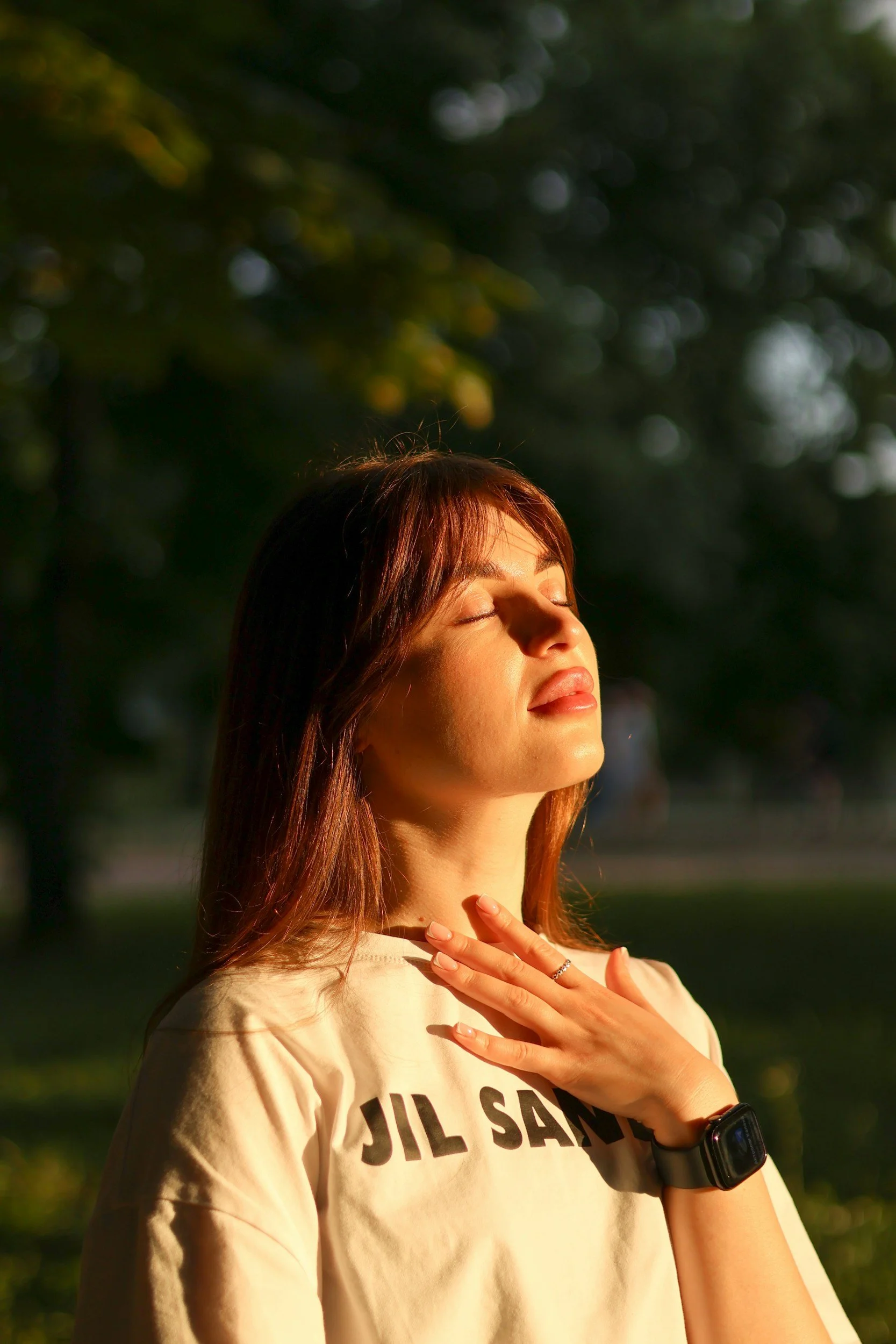
One thing you can do in that moment is take a slow, intentional, deep breath.
Let the exhale be longer than the inhale.
Breathe less into your chest and more into your diaphragm.
Not because this is trendy or “woo-woo,” but because this is how your nervous system works.
When you slow your breathing, you are sending a signal of safety to your body.
Something called the parasympathetic nervous system kicks in, and it helps your body come out of panic mode and into a calmer state. It allows you to do what you need to do without feeling completely hijacked by anxiety.
A few deep breaths are not going to make your problems disappear.
That is not what I am saying.
However, it can take your anxiety from a ten down to a six.
Anxiety is a lot easier to manage at a six than it is at a ten.
Why Coping Skills Help, But Aren’t the Whole Answer
The way I like to think about this is like a firefighter and a house on fire.
When your house is on fire, you need the firefighter.
Breathing and grounding are like that. They help put out the fire in the moment.
However, if your house keeps catching on fire and the firefighter keeps having to come back, you eventually have to ask, why does this keep happening?
You are not meant to live your life in constant coping mode.
If you are using tools and skills all the time and still feeling anxious most of the time, then we are probably treating the symptom and not the root.
Getting to the Root of Anxiety
A lot of the time, anxiety starts when we are very young.
Maybe you were a worrier as a child.
Maybe you had stomach aches and did not know it was anxiety.
Maybe you learned early on that mistakes were not safe.
Maybe being embarrassed felt deeply shameful.
I often ask people to imagine the little girl inside of them.
What was she worried about?
What was she scared of?
What did she believe would happen if she messed up, looked foolish, or disappointed someone?
She is still there, and she is still trying to protect you.
She does not want you to ever feel that same kind of vulnerability again. Because we feel things more intensely when we are young and powerless, your nervous system learned to stay on high alert.
As adults, we can tell ourselves logically, “This is not a big deal anymore.”
However, your nervous system is not wired by logic alone.
Those experiences still matter.
Why Compassion Changes Everything

When anxiety shows up, many people meet themselves with criticism:
“Why am I like this?”
“Why can’t I get over this?”
“This is so dumb.”
That does not help your body feel safe.
It actually makes anxiety worse.
Compassion does something different.
When you imagine that little girl and what she went through, it becomes easier to understand why your system reacts the way it does. It becomes easier to be kind instead of harsh. This kindness allows space to be curious about what is underneath the anxiety, instead of seeing it as a defect or a failure.
Deep breathing and grounding help in the moment, and they are tools you will always need from time to time.
Back to the firefighter example: you do not deserve to live like your house is on fire all the time.
The more you understand your anxiety, the more compassion you offer yourself, and the more you work through the experiences that shaped it, the lower your overall level of anxiety can become. Over time, your body learns safety more easily. Something called vagal tone strengthens, and it becomes easier for your nervous system to calm down when stress hits.
When Anxiety Therapy in Salt Lake City, Utah Can Help
Anxiety is a normal human response. It does not automatically mean something is disordered or broken. It means your body and brain are trying to protect you.
If you are using coping skills often and still feeling anxious much of the time, anxiety therapy in Salt Lake City, Utah, can help you get to the root of what your anxiety is about instead of only managing the symptoms.
If you are a woman in Utah and want support, you can book a free 15-minute consultation at the link below. We can talk about what you are dealing with and whether online therapy would be a good fit for you.
Why Online Anxiety Therapy in Salt Lake City, Utah Can Work Just as Well

A lot of people worry that online therapy will not feel the same as being in the room together. They wonder if their therapist will miss their body language, their facial expressions, or the small shifts that happen when emotions come up.
In practice, those things are still very visible on video. I can see when someone’s shoulders tense, when their breathing changes, when their eyes fill with tears, or when they start to pull back. We still track tone of voice, pauses, and the way emotions show up in the body. Many people also find it easier to open up from the safety of their own home. They are not rushing through traffic, sitting in a waiting room, or feeling exposed walking into an office. For anxious nervous systems, that sense of comfort and control can actually make it easier to be honest, to stay present, and to do deeper work. The relationship, the safety, and the emotional attunement are what matter most in therapy, and those can absolutely happen through secure video sessions.
I provide online therapy in Utah. This includes clients in Salt Lake City, Provo, Orem, Park City, Lehi, Draper, St. George, Cedar City, Logan, Ogden, and surrounding areas. Therapy sessions are done through secure video, so you can receive support from anywhere in Utah without having to travel to an office.
About the Author

Ashlee Hunt, LCSW, is a licensed clinical social worker and the owner of Maple Canyon Therapy, where she provides online anxiety therapy for women in Salt Lake City and all across Utah. She holds a Bachelor of Science in Psychology and a Bachelor of Science in Family Life and Human Development from Southern Utah University, as well as a Master’s degree in Social Work from Utah State University.
In addition to her clinical work, Ashlee has served as an adjunct professor at Utah State University, teaching beginning social work practice and helping students learn the foundations of therapeutic work, ethics, and client care. Her approach to therapy is relational, trauma-informed, and grounded in helping women understand the roots of anxiety rather than only managing symptoms.
Ashlee specializes in working with high-functioning, sensitive women who struggle with overthinking, fear of making mistakes, people-pleasing, and long-standing anxiety patterns. She offers secure online therapy throughout Utah, including Salt Lake City, Provo, St. George, Cedar City, Logan, and surrounding areas.